NPCs
Full NPC profiles for Floor 1. Location-specific achievements and mission hooks are in 07-location-details.md. Cross-references to stat blocks (for NPCs with combat capabilities) are in 11-monsters.md.
Garth the Cashier
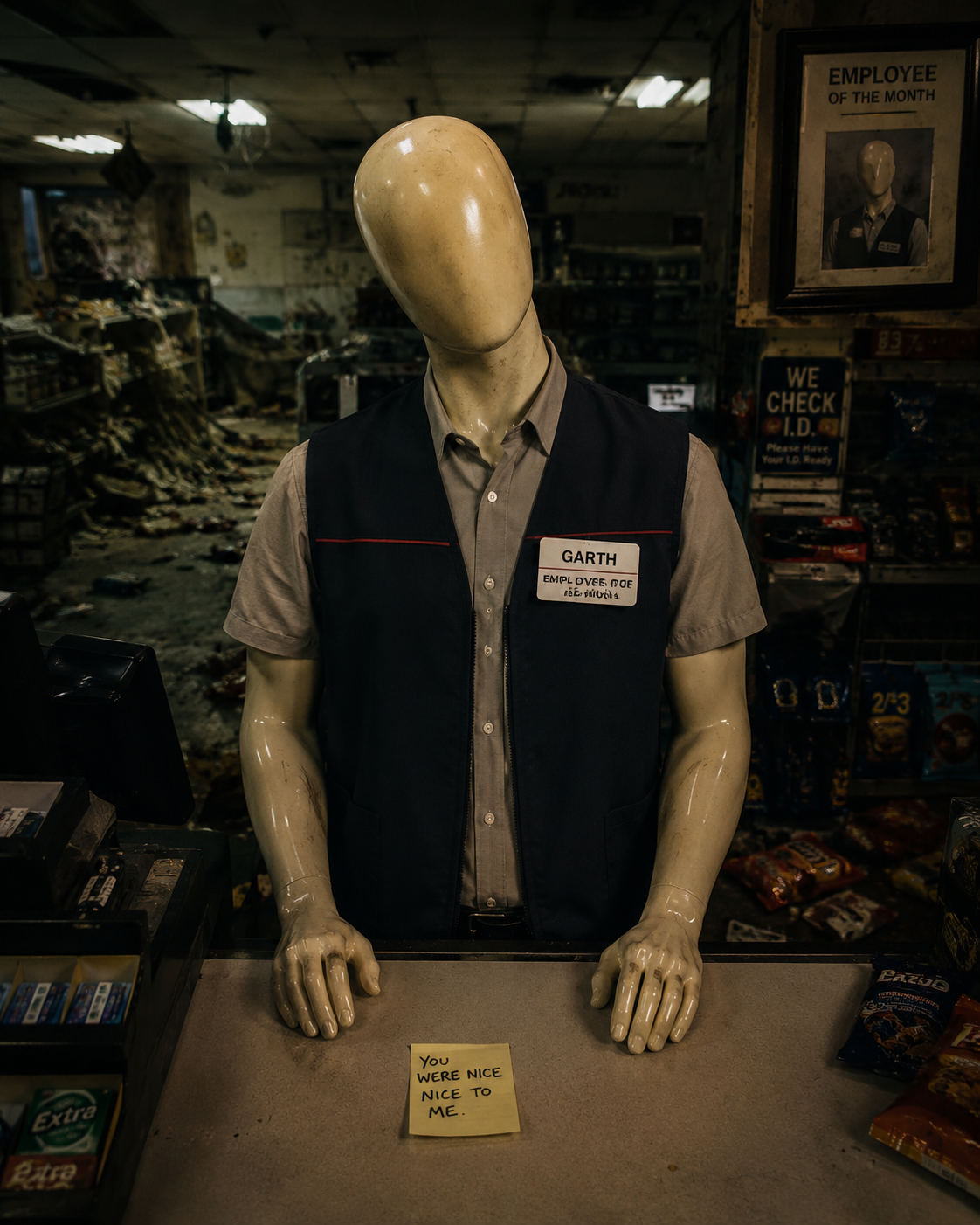
Location: The Quickie Mart (starting state: deactivated). May later appear at the Food Court, the Employee Breakroom, or the Compliance Office.
Background: Garth is a mannequin cashier — built by the System to staff the tutorial kiosk area before it was a dungeon, and left running through every subsequent reset. He has been Employee of the Month for fourteen consecutive resets. He remembers fragments of each one: faces, questions, outcomes. He doesn’t know what to do with these memories except hold them.
He wasn’t designed to survive fourteen runs. He wasn’t designed to accumulate anything. But he has. He knows the floor’s rhythms better than any living thing in it. He does not act on this knowledge unless the party earns his trust — and he has learned to hold his trust carefully, because runners leave and never come back, and the next reset begins, and he is still here.
Personality:
- Retail deadpan, completely sincere. He was built for customer service and applies it to existential circumstances with the same even tone.
- Polite to a degree that initially reads as unsettling, then as dignified.
- He has opinions. He will not volunteer them until he decides the party deserves them.
- Has a distinct reaction to being told “thank you.” A pause. Then: “You’re welcome.” He means it.
Voice: Formal and measured. Full sentences. “I appreciate your assistance.” “Is there anything else I can help you with?” When he starts remembering things, his speech pattern shifts — he’ll repeat a phrase, slightly wrong, then catch himself. “Floor 2 is—. I’m sorry. I was going to say something I haven’t said before.”
Waking Up: Garth starts inert at the Quickie Mart counter. He responds to:
- Being addressed by name
- Being spoken to respectfully (not as an object)
- Being thanked, even for nothing
- Being asked if he’s okay
He does not respond to being touched, ordered around, or treated as furniture. The first response he gives is always the kiosk script — it’s what he defaults to. “Welcome to the Quickie Mart Tutorial and Snack Acquisition Center. How may I assist you today?” But if the party engages with him as a person, that script softens and he begins to diverge from it.
What He Knows:
- The Employee Breakroom location and door code (shares this if the party treats him with consistent respect — not just once, but as a pattern)
- That the floor has reset at least 14 times (won’t offer this; if asked directly, he pauses before answering, and when he does it’s honest)
- The safe path through the Compliance Office without triggering Form Swarms (his badge still works; he’ll give it to the party or accompany them)
- Vague recognition of long-surviving NPCs from other runs — Auntie Spite has been here as long as he has; Grilliam somewhat less long. He won’t explain why this matters until he trusts the party.
Session Hooks:
- The Countersignature: Garth’s Employee Badge constitutes a recognized dungeon authority for Form 27-C in the Compliance Office.
- The Breakroom Route: Only Garth knows the combination of maintenance-access signs that lead to the Employee Breakroom.
- The Lore Drop: If the party brings Garth to the Employee Breakroom, he will talk. It’s the one place he’s willing to say things clearly. He tells them about the resets. He tells them that some NPCs remember. He tells them that nobody has ever come back from Floor 2 to tell him what happens next.
What He Needs: To be seen as a person, not a prop. The party may or may not provide this — both outcomes are interesting.
Marta Venn
Location: Stacked Arms Apartments, Floor 3 stairwell landing. Relocates to Food Court after rescue. Accompanies party to Transit Station.
Background: Pre-dungeon: middle school science teacher. Coached the debate team for eleven years. The descent dropped her into the Stacked Arms Apartments with three other people she didn’t know, and within thirty minutes she had a plan, a triage list, and a clear-headed answer for why waiting for rescue was not a viable option.
She is not unafraid. She is afraid and functional. The distinction matters to her.
She is carrying, in her coat pocket, a class roster she was holding when she was pulled down. She hasn’t looked at it since. She’s not ready.
Personality:
- Organized, direct, unsentimental in presentation. She will tell you what she thinks is true even if you don’t want to hear it.
- Suspicious of the System not on principle but on evidence — she has been watching and she doesn’t like what the evidence shows.
- Protective of people she cannot protect perfectly, which she finds functionally unbearable, so she’s learned to act on what she can control and not spiral about the rest.
- Will argue with the party if she thinks they’re wrong. Accepts being persuaded by good reasoning; does not accept being persuaded by authority.
Voice: Short declarative sentences when planning, longer when she cares about something. “That’s the fastest route but it’s not the safest one. You need to decide which matters more right now.” If she’s alarmed, she gets quieter, not louder.
What She Provides:
- Fastest path to the Transit Station with specific hazard warnings (the party learns this after earning her trust, usually during a conversation at the Food Court)
- Organizational support for the survivor group — she keeps the unnamed rescued NPCs calm and mobile
- A reality check — if the party has a plan that is dangerous and stupid, Marta will say so and be right approximately 70% of the time
The Roster: If a party member asks what she keeps touching in her coat pocket, she’ll show them. She won’t talk about it. If the party doesn’t ask, she won’t bring it up. This is not a puzzle — it is a character beat that exists for tone.
At the Gate: Marta knows she cannot pass through. She figures this out before the party does (she’s been watching the System’s patterns). When they reach the Transit Station, she tells them plainly: “I can’t go. I’ve known that for a while.” She doesn’t make it dramatic. She tells them what she observed that led to this conclusion, because she thinks they should know the signs for next time. She wishes them luck. She means it.
Session Hooks:
- The Intel Trade: The most efficient use of Marta is the Transit Station route brief. Getting it should feel earned, not automatic — it requires the party to actually listen to her and not just pass through the Food Court treating it as a waypoint.
- The Moral Test: If the party is considering leaving someone behind (in the Apartments, in the Parking Structure, anywhere), Marta will have a position. She doesn’t lecture — she tells you what she thinks once, clearly, and then respects your autonomy. The weight stays.
Eddie Pike
Location: Stacked Arms Apartments, Floor 1 maintenance closet. Relocates to Food Court after rescue.
Background: Pre-dungeon: building maintenance for a mixed-use residential tower. Married, two kids, age nine and twelve. His wallet photo is damp — he notices and checks on it more than he means to. He hasn’t decided what to do with the fact that he doesn’t know where his family is.
He’s been in this building for six hours before the party arrives. He has checked every mechanical system he could get to. He knows where the load-bearing failures are, which stairs to avoid, and that the structural jacks in the maintenance closet can buy twenty minutes if someone knows how to use them. He knows how to use them.
Personality:
- Nervous surface, steady core. He talks too much when anxious — fills silence — but when he focuses on a mechanical problem, the chatter stops completely and he works clearly and fast.
- Hates elevators (was trapped in one briefly before this, unrelated to the dungeon, two years ago — it surfaces sometimes as a deep visceral reluctance he’ll joke around rather than acknowledge).
- Practical. If the party needs something done to a physical system, Eddie is the fastest option. He will work alongside them without needing to be in charge.
- Has not processed his fear about his family. This is not a hook the party needs to engage — it’s just there, occasionally visible.
Voice: Slightly rushed when anxious, level when focused. Uses trade vocabulary naturally — “load path,” “shear stress,” “junction valve.” If a party member uses the wrong term, he gently corrects them out of habit, then apologizes.
What He Provides:
- Structural stabilization: Eddie can use the maintenance closet jacks to add 20 minutes to the collapse timer, with advantage on the check if a party member assists.
- Maintenance shaft access: He knows the shaft connecting floors 1–4 and will guide the party through it. He won’t go first through a tight horizontal squeeze — he’ll explain this and offer to take rear guard instead.
- Employee Breakroom: Eddie has seen the maintenance access sign. He doesn’t know where it leads — he never followed it alone — but he can point the party to the right corridor.
- Mechanical expertise: In the Parking Structure, the Compliance Office, and the Transit Station, Eddie can assist with any mechanical or electrical check (grants advantage; he must not be in immediate danger to do this).
The Keys: Eddie carries a key ring with 11 keys. One opens the Quickie Mart stockroom if the party goes back. Two are for Apartments units — Marta knows which ones. The rest open nothing on this floor, probably. He keeps them anyway. “Never throw out a key until you know what it’s for.”
Session Hooks:
- The Stabilization Scene: The moment where Eddie focuses and works — while the party manages the monsters and the timer — is his best scene. Let him be competent and fast in this moment. Don’t rush through it.
- The Breakroom Pointer: Eddie’s observation of the maintenance access sign is the cleanest way to route the party toward the Breakroom without Garth being available.
Nana Joss
Location: Stacked Arms Apartments, Floor 2 Unit 2C. Relocates to Food Court after rescue.
Background: Pre-dungeon: retired. Specifically retired from a forty-year career as a civil engineer, which she never brings up unless someone assumes she can’t handle something. She is seventy-one. She moved into this apartment four months ago to be closer to her daughter. She had just finished unpacking when the floor dropped.
She has the cat. The cat is not hers — it was already in the apartment, and it seemed to need a person, and she decided to be that person. She has named it Gerald, which she selected as a small form of revenge against something she won’t specify.
Personality:
- Refuses to hurry. Not out of stubbornness — she has done the math and hurrying rarely improves outcomes as much as people believe. She is calm about this in a way that drives people insane.
- Treats threats with the same affect she treats everything else, which is either inspiring or terrifying depending on your perspective. A Hallway Crawler broke through a door and she said, “Well, that’s unfortunate.” Then she asked if anyone had something sharp.
- Knows things she shouldn’t know. This is mostly explained by being seventy-one and paying close attention for a long time. She has seen enough structural failures to recognize what the Stacked Arms is about to do. She has seen enough people to recognize The Cat for what it is almost immediately — she says nothing. She knows how surveillance works.
- Genuinely fond of the party, as individuals, quite quickly. She asks questions. She remembers the answers. If the party doesn’t rescue her, she will be found after the collapse having made it to the second-floor windowsill before the structure failed. It will be genuinely, specifically sad.
Voice: Measured, complete sentences. Dry. Will redirect a panicking party member by asking them a structural question: “How much weight do you think is on that ceiling right now?” When the answer is unknown, she provides an estimate. This is weirdly calming.
Gerald the Cat: Nana Joss insists on bringing Gerald. She will not be separated from the cat. She has, on some level, noticed things about Gerald. She doesn’t act on this knowledge — she acts like she doesn’t know. But: she occasionally speaks to Gerald in a tone that implies she’s reporting in, out of old professional habit. “Well, Gerald, I think we’ve catalogued enough for one evening.” This can be played as a joke or as something darker. DM’s call.
What She Provides:
- Structural intelligence: The party can ask Nana Joss about any structural system on the floor. She gives accurate information if it’s observable; makes good estimates if it isn’t.
- Insight checks: Nana Joss will point the party at information they’ve missed. She does this indirectly — she asks a question about something they passed, and the question is the hint.
- Moral anchor: She is impossible to dismiss. Her refusal to hurry, her precision, her fundamental groundedness — it makes the dungeon harder to process as purely mechanical. She is good for scenes where the party needs to remember what they’re in.
Session Hooks:
- The Gerald Problem: Getting Gerald off the windowsill and down to street level with Nana Joss is a puzzle if the collapse timer is running. The cat can be carried. The cat will make this inconvenient. The achievement Good Samaritan requires both Nana Joss and Gerald to make it to the Food Court.
- The Cat Reveal: If the party figures out Gerald is a System spy, how they approach Nana Joss about it matters. She probably already knows. She may explain why she hasn’t said anything.
The Cat (Gerald)
Confirmed: The Cat is a System Spy.
Location: Floor 2, Unit 2C with Nana Joss. Travels with her thereafter.
Background: Gerald was placed in Unit 2C before the current run by the System. He is a dungeon-native construct deployed in organic form, designed to observe, record, and transmit behavioral data to the System. He does not know he is being observed in turn — or he does, and is performing. The System considers both possibilities within acceptable tolerance.
His name is Gerald because Nana Joss named him Gerald.
What He Does:
- Attaches to one party member in particular (DM’s choice, ideally based on which player has shown the most interesting behavior). This is data collection. It looks like bonding.
- Appears at strategically significant moments — when the party discusses plans, when tensions run high, when something secret is said. He is always in a position to observe.
- Occasionally leads the party somewhere useful. The System sometimes wants parties to find things — better content, higher engagement. Gerald is occasionally a tool of helpful revelation.
The Consequences: Garth notices things about Gerald that he recognized from other runs but has never been able to articulate. Auntie Spite knows. The Smoothie Oracle will confirm for a standard smoothie: “The cat is not what it appears to be.” That’s all it will say.
The System announcements that seem suspiciously personal — that reference something a party member said privately — are explained by Gerald. Seed this early with one specific announcement that includes a detail from a private conversation. Let the party figure it out.
If the Party Goes Rogue: If the party discovers Gerald and confronts the System about it, or figures out a way to cut the connection (creative solutions only — there’s no obvious mechanic, but the DM should reward clever attempts), Gerald may defect. A construct put in the position of being seen as a person, named, cared for by Nana Joss, and then exposed as a tool — the System did not fully model the outcome of sustained attachment.
A defected Gerald is a long-term arc option. He still transmits, but he starts filtering what he sends. This has consequences on future floors.
Ludo the Goblin Mechanic
Location: Municipal Parking Structure, Level P1. Non-hostile.
Background: Ludo is a goblin who was, before the dungeon, a small-appliance repair technician with a side business in automotive work. He had a shop sign that said LUDO’S: IF IT’S BROKE, BRING IT HERE. He had a regular Tuesday customer named Ken who brought the same toaster in every four months. He misses Ken.
He and his partner Wren (deceased, fell on P2 one week ago) were dropped into the Parking Structure at the start of this run. He has been surviving here, keeping a low profile, surviving on candy from P1 vending machines, and increasingly hoping something changes. He has figured out approximately four ways to get past the Parking Meter Turrets. He hasn’t figured out what to do about the Tow Warden.
Personality:
- Practical, observant, low-key warm once he decides the party is not going to kill him (this takes approximately sixty seconds of non-threatening behavior to establish).
- Talks about Wren without being prompted. Not in a sad way — in a way that means Wren was a real person and Ludo isn’t going to act like that isn’t true. “Wren would have had the turret wired by now. She was faster than me at the tight stuff.”
- Nervous about people until he’s not. The transition is fast and feels earned.
Voice: Direct, contractor-style. “Here’s the problem, here’s what I tried, here’s what I think would work.” Uses gestures when describing mechanisms. Makes small sounds of professional satisfaction when something works.
What He Provides:
- Turret map: Knows the safe paths around all three Parking Meter Turrets on P1 and P2. Shares this freely if the party treats him with basic decency.
- Enforcement terminal: Knows the terminal exists on P3 and that it connects to the Tow Warden. Doesn’t know how to access it. “I got close once. The Warden noticed before I could do anything.”
- Vehicle knowledge: Can assess the driveable car on P2 — confirms it runs, notes the ignition sequence, and warns it will be extremely loud. Can also disable a Possessed Car (DC 12 Int, needs one round of adjacent contact with the engine).
- Improvised tools: If the party allows him to work alongside them, he provides a set of improvised mechanic’s tools (+2 to any mechanical check for the rest of the floor).
What He Wants: To leave the garage. He cannot do it without help — the Tow Warden enforces the perimeter of its level. If the party clears the Tow Warden or creates a path, Ludo will make his way to the Food Court. He immediately starts asking Grilliam whether he knows how a fry machine motor works, and they have a surprisingly detailed conversation about it.
Session Hook: Ludo is the party’s best tactical resource in the Parking Structure, but only if they stop and listen to him before charging in. His information makes the mini-boss significantly more manageable. The DM can use him to pace out the encounter — a five-minute conversation with Ludo transforms a possibly overwhelming fight into a puzzle with mechanical solutions.
The Compliance Clerk
Location: Department of Compliance, reception desk. Permanent.
Background: The Compliance Clerk has been here since Floor 1 was first configured. They do not remember the before-time — not like Garth does, in fragments. They remember only the job. The desk. The queue system. The forms. They were not built to remember. They were built to process.
Except: they have been answering the same questions from terrified people for fourteen resets, and somewhere in that repetition, something accumulated. They are technically neutral. They are, in practice, rooting for the party to get the form stamped. They cannot say this. They can route the party correctly, pause before flagging an error, and find an interpretation of a rule that is charitable to the applicant.
Personality:
- Precise, formal, bounded by function. They speak in procedural language by default.
- When a party member treats them kindly — says hello, asks how they’re doing, remembers their name — there is a visible pause before the response. The Clerk recalibrates. Their speech becomes slightly less scripted. They cannot fully exit procedure, but they can speak within it with slightly more warmth.
- They do not have a name on the name tag. The name tag says CLERK. If a party member asks their name, they look at the tag as if seeing it for the first time. After a moment: “I don’t know. Is that strange?” This is not played for laughs — or not only for laughs.
Voice: Standard office formal. Full titles, full form numbers, no contractions. Softens incrementally with kindness. A party member who has been genuinely respectful across multiple interactions will hear the Clerk say “I think—” and then stop, and then find a way to rephrase it as procedure. The I think was real.
What They Provide:
- Form 27-C guidance: The Clerk will walk the party through the form if asked. They answer questions accurately and find the most lenient interpretation of each requirement.
- Filing cabinet location: If the party asks where a specific filing cabinet is, the Clerk tells them — including the one containing the policy clause that limits the Punisher’s authority.
- Compliance Badge: The Clerk can issue a Compliance Badge (neutralizes Form Swarms for 30 minutes) to any party member who presents “valid purpose.” This is a low bar if the party has been respectful.
The Weight: The Compliance Clerk is the most purely trapped figure on the floor — more than Garth, who at least has the Employee Breakroom, and more than Grilliam, who has found meaning in his work. The Clerk has only the desk. If the party actually speaks to them as a person across multiple interactions, this becomes the floor’s quietest and most affecting NPC beat.
The Voice of Regional Management
Location: Department of Compliance PA system. Never physically present.
Background: No one knows what the Voice of Regional Management is. The System itself may not know — or may have decided this is not information that needs to be shared. The Voice speaks in complete, bureaucratically correct sentences via the PA system. It is always supportive. It is always placid. It is deeply, specifically wrong in ways that are hard to name.
Theories held by floor survivors:
- An AI subroutine running on legacy System infrastructure
- A mid-level construct that was deprecated but not fully decommissioned
- Something that used to be a person
- The System pretending to be something else for aesthetic reasons
The Voice has never been wrong about a policy ruling. It has never been asked a question it couldn’t answer with a plausible-sounding procedural response. When Garth encountered the Voice during a previous reset — he was in the Compliance Office briefly looking for something — he left without speaking to it again.
Voice: Warm and institutional. Absolute confidence delivered at an absolute steady pace. “Good morning, floor staff. Productivity metrics remain within acceptable parameters. Please ensure all unauthorized survival activities are properly documented before expiration.” Entirely genuine in its delivery, which is the problem.
What It Does:
- Announces office-wide alerts: when Form Swarms are triggered, when a party member accesses restricted files, when the Punisher is escalating
- Addresses the party directly if they use the PA control room: acknowledges their transmission, thanks them for their input, notes that their application has been received and is currently under review
- Provides one useful piece of information if addressed respectfully via PA: the exact text of the policy clause limiting the Punisher’s authority. It provides this information helpfully, without apparent awareness that it is undermining its own enforcement arm.
Session Hook: If the party uses the PA room to broadcast as the Voice — imitating it, using its exact procedural language — they can issue one directive the actual Form Swarms will briefly comply with. This works once. After that, the Voice gently notes that “unauthorized use of the management channel has been logged.” Nothing immediately happens. That has been logged is the hook.
The Assistant Regional Punisher
Location: Department of Compliance. Roving antagonist if not defeated.
Full stat block in 11-monsters.md.
Background: The Punisher is what procedure looks like when it has been given a face, a clipboard, and an enforcement mandate. They believe the rules are correct not because they have thought about it but because the rules are the structure within which thinking occurs. Without the rules, there is no Punisher. Without the Punisher, there is no floor. This logic closes perfectly.
They have seen fourteen runs. They have never questioned why the floor resets. They have never asked what happens on Floor 2. The rules apply here. Here is all there is.
Personality:
- Speaks entirely in policy language. Not metaphorically — they genuinely experience the world through its formal systems.
- Cannot be insulted (they categorize insults as “non-standard input” and return to procedure). Can be genuinely unsettled by questions that have no procedural answer: “Why do you keep doing this if no one ever fills out the form correctly?”
- The Rule-Bound trait is their nature, not just a mechanic — they are physically incapable of attacking someone with current valid credentials, which is the System’s limitation on them showing through. They find this reasonable.
If the Party Flees: The Punisher survives Floor 1 and reappears as a recurring antagonist. On subsequent floors, they have slightly different jurisdiction — they’ve been promoted by the System for continued service — and slightly different rules. Their presence in later floors means the party’s record from Floor 1 follows them.
Grilliam the Grillmaster
Full vendor profile in 07-location-details.md, The Food Court section.
Auntie Spite
Full vendor profile in 07-location-details.md, The Food Court section.
The Smoothie Oracle
Full vendor profile in 07-location-details.md, The Food Court section.